Compare the Best Garden Fence Types in the UK: From Closeboard to Lap Panels
By Luke Clarke — over 10 years’ experience installing and supplying fencing.
Quick Overview
Detailed Comparison of UK Garden Fencing Types
Whether you’re adding privacy, securing a boundary, or upgrading your garden’s look, choosing the right type of fencing can make a big difference. From traditional Closeboard to decorative picket, each fencing style has its strengths — and knowing what works best in UK gardens helps you get the most from your space.
In this guide, we break down the most widely used fencing styles across the UK, looking at how they differ, where they’re best suited, and what to consider before making your choice.
Continuous Closeboard (Featheredge) Fencing
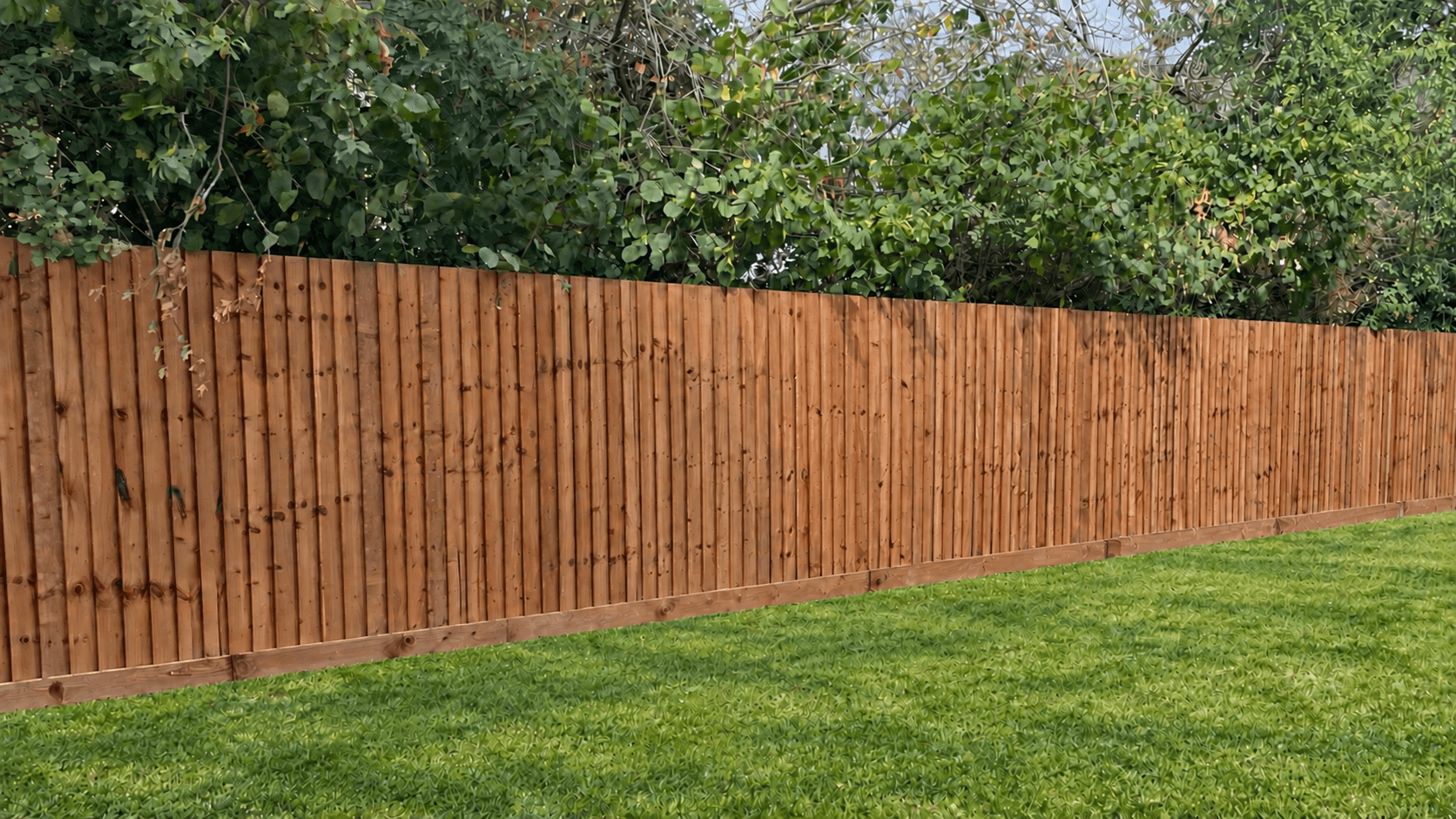
Continuous closeboard fencing uses overlapping vertical timber boards fixed to horizontal rails between posts. It forms a solid boundary for privacy. Its service life depends on the timber treatment, detailing, fixings, foundations and site conditions.
Continuous closeboard fencing is built on site from posts, rails and individual featheredge boards. A closeboard fence panel is a prefabricated section fitted between posts. Keep those two systems separate when comparing installation, dimensions and material quantities.
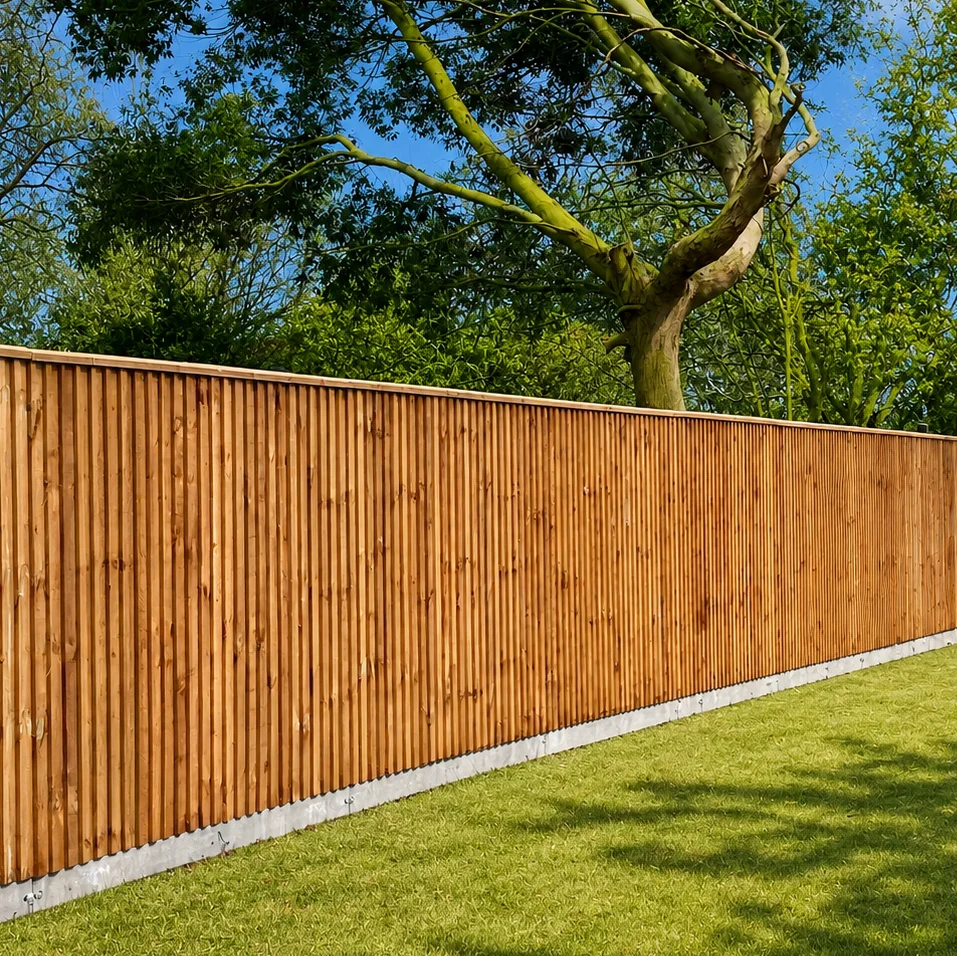
Did You Know? Concrete Posts Can Be Used with Continuous Closeboard Fencing

In a compatible recessed-post system, rails can be bolted to the posts through the provided fixing holes. Individual featheredge boards are then fixed to the rails. Follow the supplier’s fixing details for the chosen components.
Pros of traditional Closeboard Fencing
- Can be set out to follow a slope, subject to the site layout and chosen specification
- Solid overlapping boards provide privacy
- For exposed locations, specify the posts, foundations, rails and fixings for the site
- Can be built to different heights
- Can be sloped down to different fence heights to remain seamless
Cons of traditional Closeboard Fencing
- More difficult than panel fencing to replace/repair sections
- May require more specialist installation services from contractors
- Can be much more time consuming to install
Continuous closeboard fencing can use timber posts or a compatible concrete-post system. Recessed concrete posts provide a fixing position for the rails while retaining the appearance of individual featheredge boards along the fence.
Choose gravel boards made to suit the recessed posts and check the supplier’s fixing details for the rails.
Recessed concrete posts can support site-built closeboard fencing while accommodating compatible gravel boards. Confirm the rails, fixings, post sizes and foundations for the chosen system and site.
For more details on recessed post systems, take a look at our suppliers recessed concrete fence post range from FP McCann.
Planning a closeboard fencing project? Try our closeboard fencing calculator to work out exactly how many boards, rails, and posts you’ll need.
Panel Fencing
Prefabricated fence panels are sold in a range of nominal widths and heights. A nominal 6ft width is approximately 1.83m, but products described as 1.8m and 1.83m are not automatically interchangeable. Check the actual panel width, height and thickness against the post spacing, slots or fixing brackets and the gravel-board dimensions before ordering.
Closeboard Fence Panels

Prefabricated closeboard fence panels are assembled sections made with featheredge boards. They fit between compatible posts using the specified slots, brackets or fixings. Installing pre-built sections can reduce on-site assembly, and a damaged panel can be replaced individually when the system allows.
Our range includes framed and standard (unframed) closeboard panels. Their edge construction and dimensions differ, so select fixings and posts to suit the particular panel. Check the manufacturer’s instructions and actual panel thickness before combining it with timber posts, slotted concrete posts or a steel-post system.
Need help estimating your project? Use our fence panel calculator to see how many panels, posts, and gravel boards you’ll need.
Pros of Closeboard Fence Panels
- Pre-built sections can reduce on-site assembly
- Solid featheredge boards provide privacy
- Can be used with compatible slotted concrete posts; check the panel thickness and slot dimensions
- Easier to replace damaged sections
- Compare the actual board, rail, frame, fixing and post specifications; panel and continuous-closeboard systems are not automatically equal in strength
Cons of Closeboard Fence Panels
- Like all Panel Fencing the downside with fixed square panels is, when there is a ground level change you usually have to have a “step” in the fence.
- Panel fencing isn’t as “seamless” as a classic closeboard fence
Lap Panels – Waney Lap Panels – Overlap Fence Panels

Lap panels, also called waney lap or overlap panels, use overlapping horizontal timber slats held by battens or framing. They provide a solid garden boundary; compare the construction, treatment and price of the specific products.
Lap panels can be fitted between compatible posts using the specified slots or fixings. To compare cost, price the complete system, including panels, posts, gravel boards, fixings and installation, rather than assuming the style name identifies the cheapest option.
Pros for Lap Panel Fencing
- Available at a range of prices; compare panels of the same size and specification
- Traditional overlapping-board appearance
- Quick replacements
Cons of Lap Panel Fencing
- Board thickness, framing, treatment and fixings vary between products; inspect the specification rather than assuming all lap panels have the same quality.
Using Slotted Concrete Fence Posts with Panel Fencing

Many fencing styles — particularly panels — are now installed using slotted concrete fence posts. These posts have vertical channels that allow panels to slide in easily. Often referred to as “H” posts, for the shape that they resemble. The slotted design makes installation faster and future maintenance simpler.
- Won’t rot or warp over time
- Excellent strength and stability
- Easier panel replacement
- Can be used with concrete gravel boards to protect timber from ground contact
Picket Fences

Picket fences are more decorative than defensive — perfect for front gardens, flower borders, or anywhere you want a tidy boundary without blocking views or sunlight.
They’re constructed from evenly spaced vertical pales, usually with either a round or pointed top and are available in (usually) 900mm or 1200mm long.
- Aesthetically pleasing
- Doesn’t obstruct light
- Usually with rounded or pointed tops
- Can be painted or stained to suit your property
Did you know? Picket can be installed using pre-made panels or built from loose components for a more custom look. Panel options make installation quicker and more consistent, while loose pales give you the freedom to set spacing and layout exactly how you want it. We usually recommend panels for faster jobs and uniform results — especially on straight runs — but for curves, slopes, or a more traditional feel, loose picket pales and rails installed on posts are ideal.
Pros of Picket Fencing
- Classic, decorative appearance that suits front gardens and cottage-style homes
- Lets light through — ideal where visibility is important
- Easy to paint or stain in any colour to match your garden theme
- Available as panels or loose pales for custom builds
- Low-height fencing can mark boundaries without feeling enclosed
Cons of Picket Fencing
- Not suitable for privacy or security
- Gaps between pales can allow pets to squeeze through
- Timber pale ends may need more frequent maintenance
Post and Rail

Often used in rural and agricultural settings, post and rail is still a staple in garden fencing. Trust us, we install enough of it for domestic customers! Post and rail fencing offers a traditional, open-style boundary. It’s built using horizontal rails fixed between upright posts and is ideal for marking large areas without obstructing the view.
For added security or to keep pets in and wildlife out, it’s often combined with galvanised wire mesh or stock fencing.
- Farms and paddocks
- Equestrian settings
- Large or open gardens
- Driveways and estate boundaries
Pros of Post and Rail Fencing
- Cost-effective for long runs and large boundary areas
- Ideal for open, rural, or country-style gardens
- Allows views and airflow — great for fields and driveways
- Can be paired with wire mesh to keep pets in or wildlife out
- Simple construction with wide availability of materials
Cons of Post and Rail Fencing
- Not suitable if privacy is a priority
- May require additional materials like mesh for secure boundaries
- Not ideal for small gardens or high-traffic urban settings
Acoustic Fencing

Acoustic fencing is designed for projects where reducing noise is a specific requirement. It can be considered for gardens near roads or other noise sources, but its suitability depends on the site and barrier design.
Acoustic systems differ in construction: reflective and absorptive barriers work differently. Check the manufacturer’s tested ratings for the particular product rather than assuming every solid timber fence absorbs or blocks sound to the same degree.
The result on site depends on the barrier’s height, length, position, gaps and installation, as well as the noise source. Compare the complete specified system and installation cost; a product’s laboratory rating is not a guarantee of the reduction at every property.
Pros of Acoustic Fencing
- A tested acoustic system can reduce noise when designed and installed for the site
- Can provide a solid privacy boundary as part of the acoustic design
- Often available in timber finishes that still look good in domestic settings
Cons of Acoustic Fencing
- Requires a quote for the specified barrier, supports, foundations and installation
- Weight and structural requirements vary by system and may require specialist design or installation
- Installation method and time depend on whether the specified system uses panels or components assembled on site
Choosing the Right Fence for You
Need fencing supplied or installed? Get in touch today using the contact form below
Fencing FAQ
Are closeboard panels better than lap panels?
Closeboard and lap panels differ in construction. Compare the actual board thickness, rails, framing, treatment and fixings rather than assuming every closeboard panel outperforms every lap panel. For an exposed site, assess the posts and foundations as well.
What should I check when comparing fence panels?
Closeboard and lap are familiar garden-panel styles. Check the actual width and height of the product you choose; nominal sizes do not guarantee compatibility with every post system.
What fence is best?
For a solid boundary, compare prefabricated closeboard panels with continuous closeboard assembled on site. Lap panels offer another panel option, while picket and post-and-rail systems provide more open boundaries. Choose from the actual product specifications and installation requirements rather than treating the style name as a strength rating.